
Featured Plant: Crinum Lilies — Giant Flowers, Tropical Foliage and a Florida Native in the Family


Some plants earn their place in a Florida landscape with flowers.
Others do it with foliage.
Crinums manage to do both.
These bold members of the amaryllis family have been grown in Southern landscapes for generations. Their broad, strap-like leaves can create a tropical presence even when the plants are not flowering, while mature specimens can suddenly send up tall stalks topped with clusters of white, pink, rose or striped flowers.
Around Sarasota, two forms we especially like are the massive green Giant Crinum and the darker, more dramatic Queen Emma Crinum.
But there is another member of the group worth knowing: Florida’s native Swamp Lily, Crinum americanum.
Together, they show just how diverse this group can be.
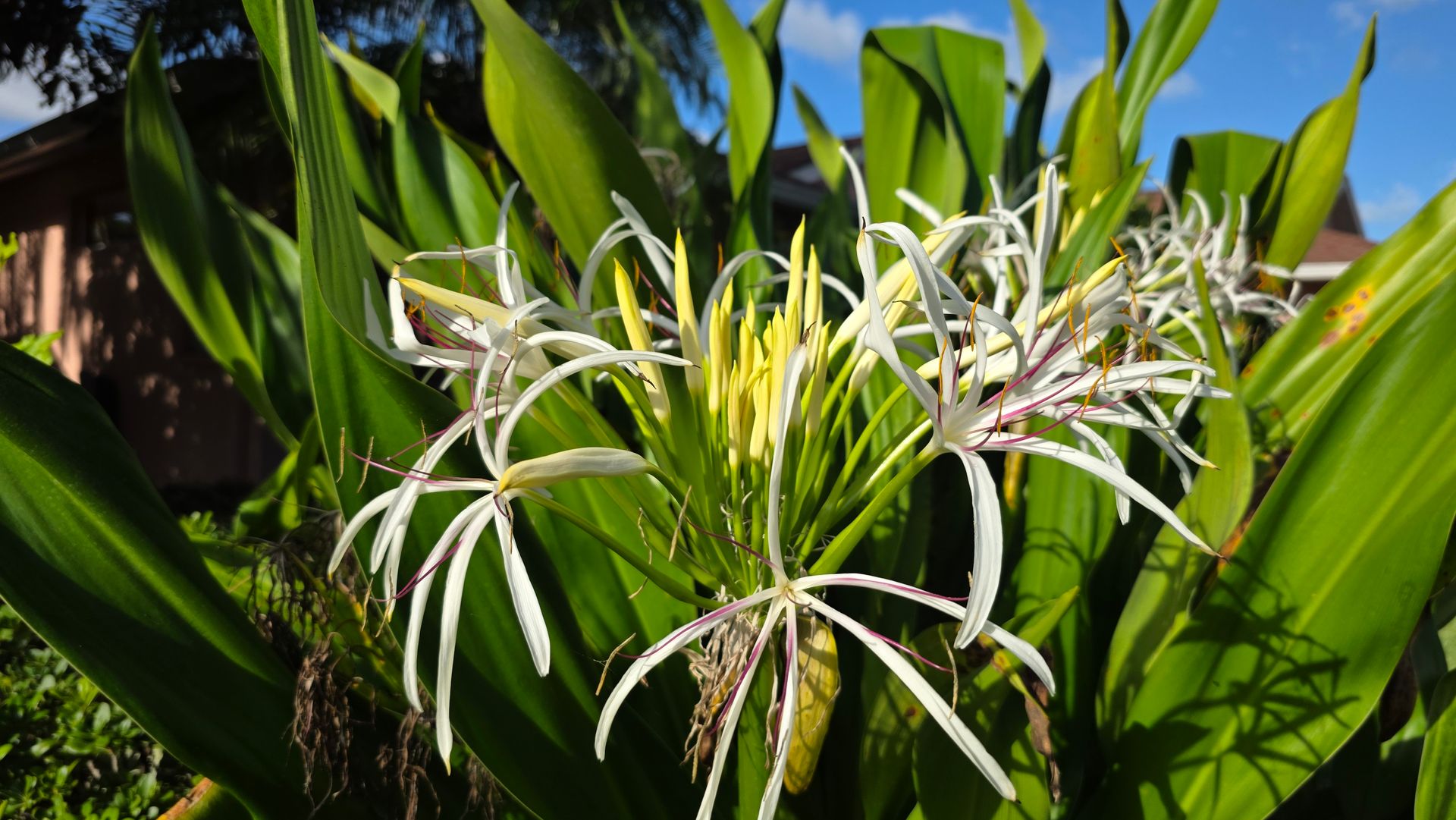
Why Crinums Stand Out in Florida Landscapes
Crinums are not delicate little flowering bulbs.
Depending on the species or cultivar, they can become substantial landscape plants.
UF/IFAS notes that Crinums vary considerably in size. Some remain relatively compact, while larger forms can reach several feet tall and wide. Their flower stalks often rise above the foliage carrying clusters of fragrant blooms that may be white, pink, rose, striped or combinations of those colors.
Below the flowers is a dense mass of strap-shaped foliage.
Some types remain bright green. Others develop bronze, burgundy or purple coloration.
Once mature, larger Crinums can become several feet across.
That size is part of their appeal, but it is also something homeowners should understand before planting one beside a walkway, doorway or narrow foundation bed.
These are plants we generally want to give some room.
Three Crinums Worth Knowing in Florida
The Crinum genus includes numerous species, hybrids and old garden selections, but three are especially useful for understanding how different members of the group can be.
Giant Crinum — Big, Green and Hard to Miss
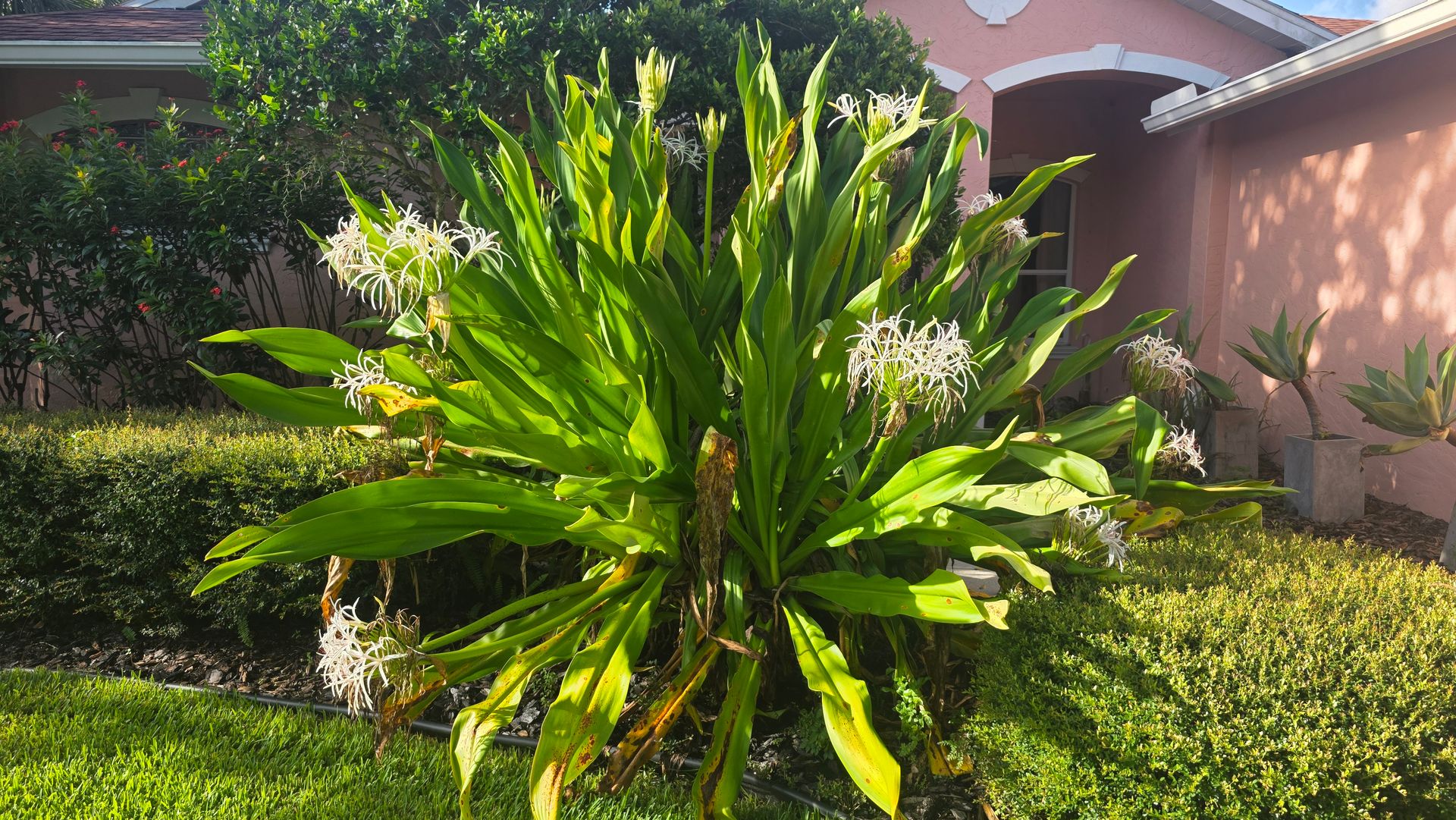
Giant Crinum, Crinum asiaticum, is one of the largest and most recognizable Crinums commonly used in Florida landscapes.
The plant develops a substantial mass of broad green leaves surrounding thick stems and large bulbs.
When it flowers, tall stalks rise above the foliage carrying clusters of long, narrow white petals with contrasting stamens.
From a distance, the flowers can almost resemble oversized white spiders.
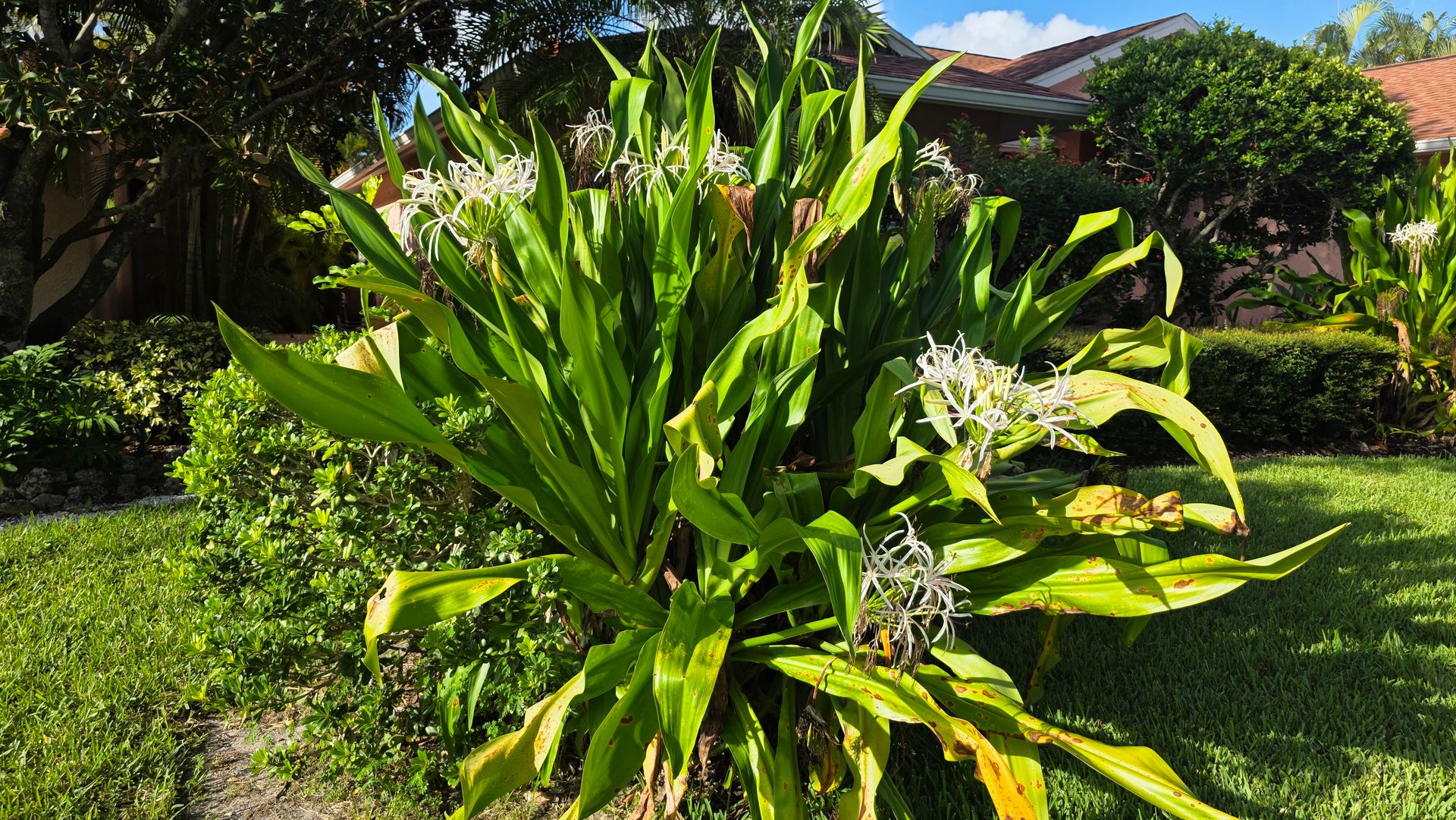
Giant Crinum can work well:
• As a large specimen or accent plant
• Near palms and other tropical foliage
• In broad foundation beds
• In tropical or subtropical garden designs
• Around pool areas where there is sufficient room
• As a backdrop behind smaller shrubs and accent plants
This is not a plant we would squeeze into a narrow planting strip and expect to stay small indefinitely.
A mature Giant Crinum wants space.
Queen Emma Crinum — The Darker Side of the Family
Queen Emma Crinum immediately looks different from the typical green-leaved Crinums.
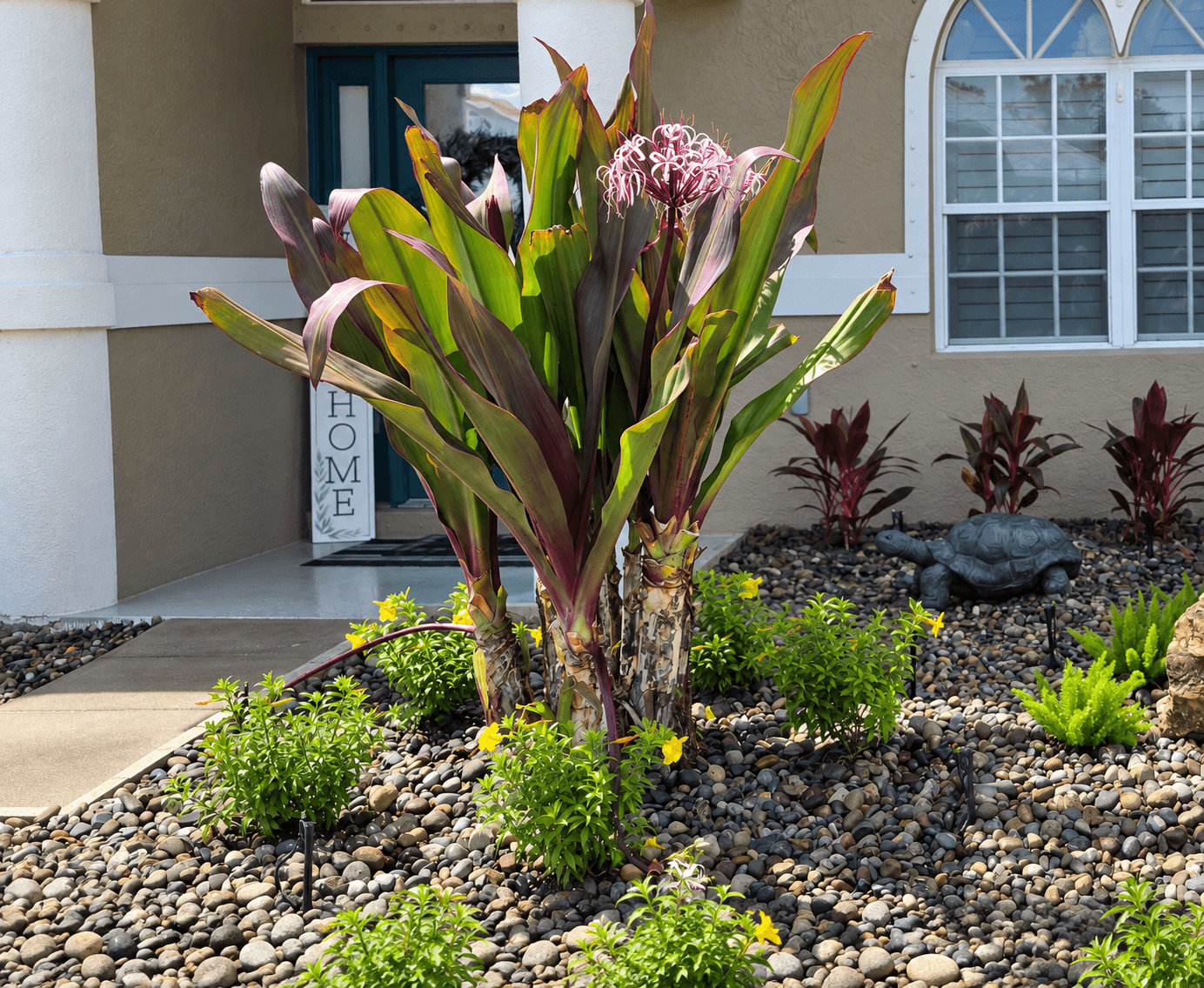
When grown with strong light, the foliage can develop rich bronze, burgundy, purple-red and green tones that make the plant stand out even when it is not flowering.
In more shaded conditions, that color can become less intense and the foliage may appear much more dark green. We have seen this ourselves in Sarasota landscapes — Queen Emma growing with less sun can still be healthy and attractive, but it may lose much of the dramatic burgundy coloration that makes the plant so distinctive.
That makes light exposure important not only for flowering, but also for the foliage color homeowners are usually trying to achieve with this plant.
Then the flowers add another layer.
Queen Emma produces large clusters of white-and-pink flowers carried above darker stems and foliage.
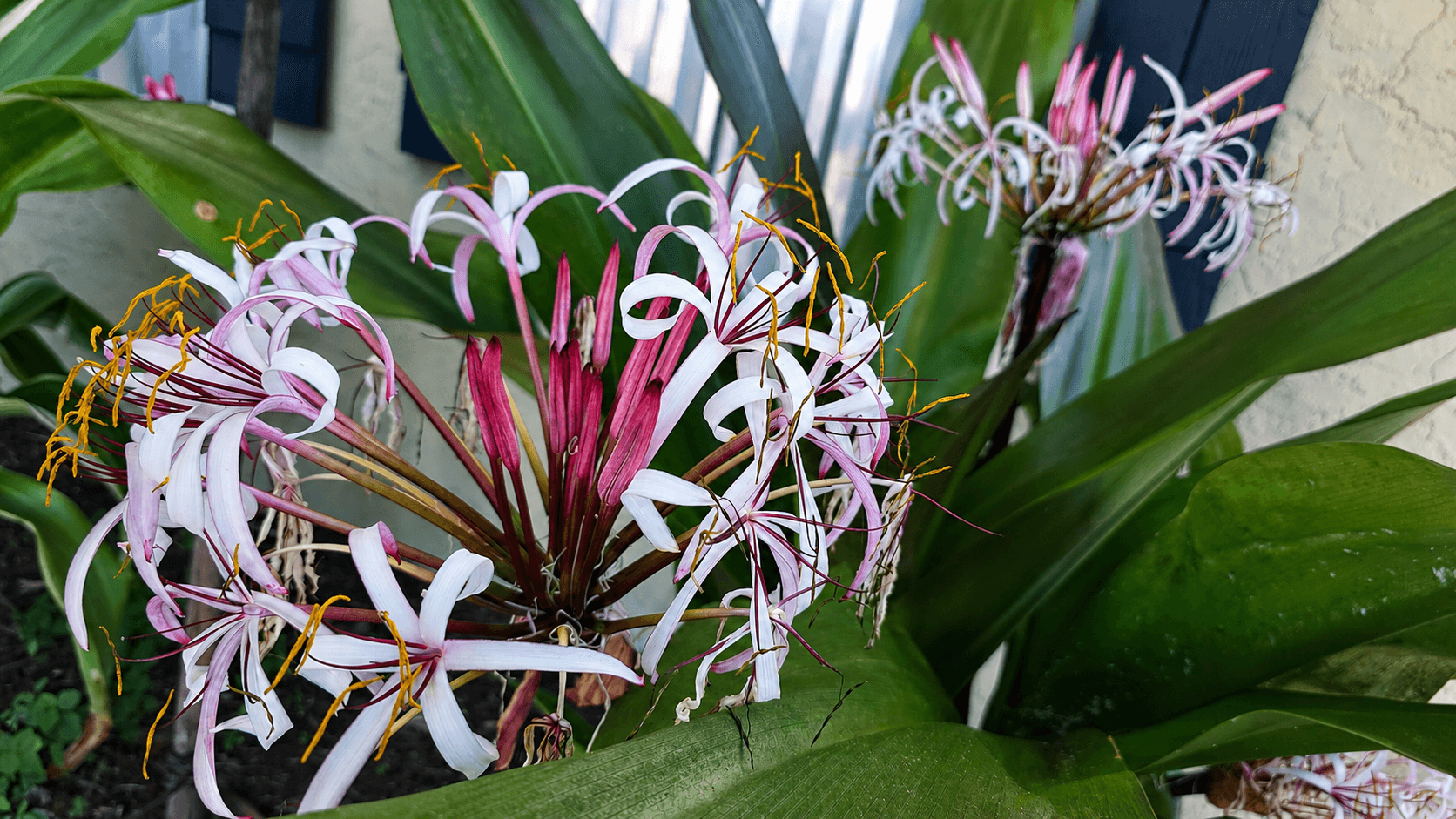
Where Giant Crinum gives us a bright green tropical mass, Queen Emma can introduce darker foliage and stronger contrast.
That makes it especially useful around lighter-colored stone, gravel, cream-colored homes and beds containing yellow, chartreuse or bright-green companion plants.
In the right design, Queen Emma can function almost like a piece of living architecture.
Florida Swamp Lily — Our Native Crinum
Not every Crinum growing in Florida came from somewhere else.
Florida Swamp Lily, Crinum americanum, is native to Florida and the southeastern United States.
It is noticeably different in scale and habitat from the huge ornamental Crinums commonly planted around homes.
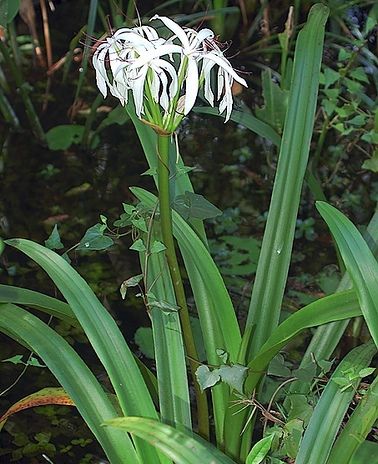
Swamp Lily generally grows only a few feet tall, with narrower strap-shaped foliage and fragrant white, spider-like flowers held above the leaves.
Its natural habitat tells us a lot about where it belongs.
Florida Swamp Lily naturally occurs around wetlands, swamps, stream banks, pond margins and other moist locations.
That makes it particularly well suited to:
• Rain gardens
• Pond edges
• Drainage areas
• Water gardens
• Moist naturalized plantings
• Areas that remain consistently wetter than the surrounding landscape
This is a useful reminder that being a Florida native does not automatically mean a plant belongs everywhere in Florida.
Swamp Lily is native here because Florida provides the wet habitats it evolved to occupy.
Place it in a hot, dry bed that rarely receives water and you are working against the plant instead of with it.
Right plant, right place still matters.
There Are Many More Crinums
The Crinum genus includes numerous species, hybrids and old garden selections, and they can look surprisingly different from one another.
Some produce the familiar white spider-like flowers seen on Giant Crinum, while others develop pink, rose, striped or deeper-colored blooms.
Crinum × amabile (the × indicates a hybrid) is one example of that diversity.
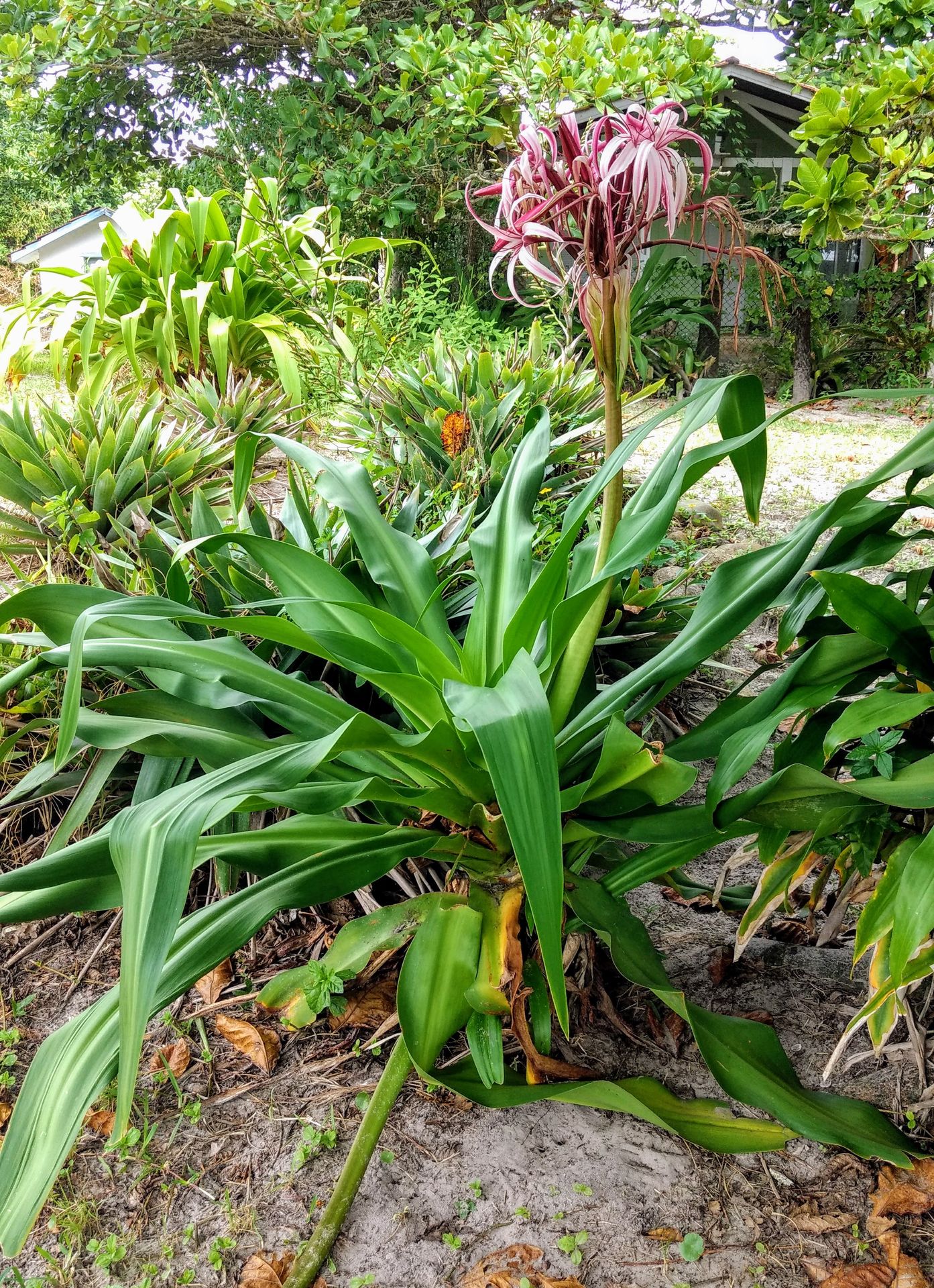
The existence of so many similar species and hybrids is also why common names can become confusing. A plant casually called “swamp lily,” “spider lily,” or simply “Crinum” may not be the same plant being referred to somewhere else.
Scientific names help us separate them more accurately.
Crinums Can Become Long-Term Landscape Plants
One of the more remarkable characteristics of Crinums is how persistent they can be.
UF/IFAS has noted that Crinums have survived around old Southern homesites and other long-established landscapes for many years with surprisingly little attention.
Their underground bulbs store significant energy.
That allows established plants to recover after foliage damage, pruning or seasonal stress.
Some mature Crinum bulbs can also become remarkably large.
These are not disposable seasonal flowers.
Plant a Crinum in the right location and you may be looking at the same plant for many years.
Give Them Enough Room
This is probably one of the most important practical lessons with the larger Crinums.
A young plant can look relatively manageable in a nursery container.
A mature plant can be enormous by comparison.
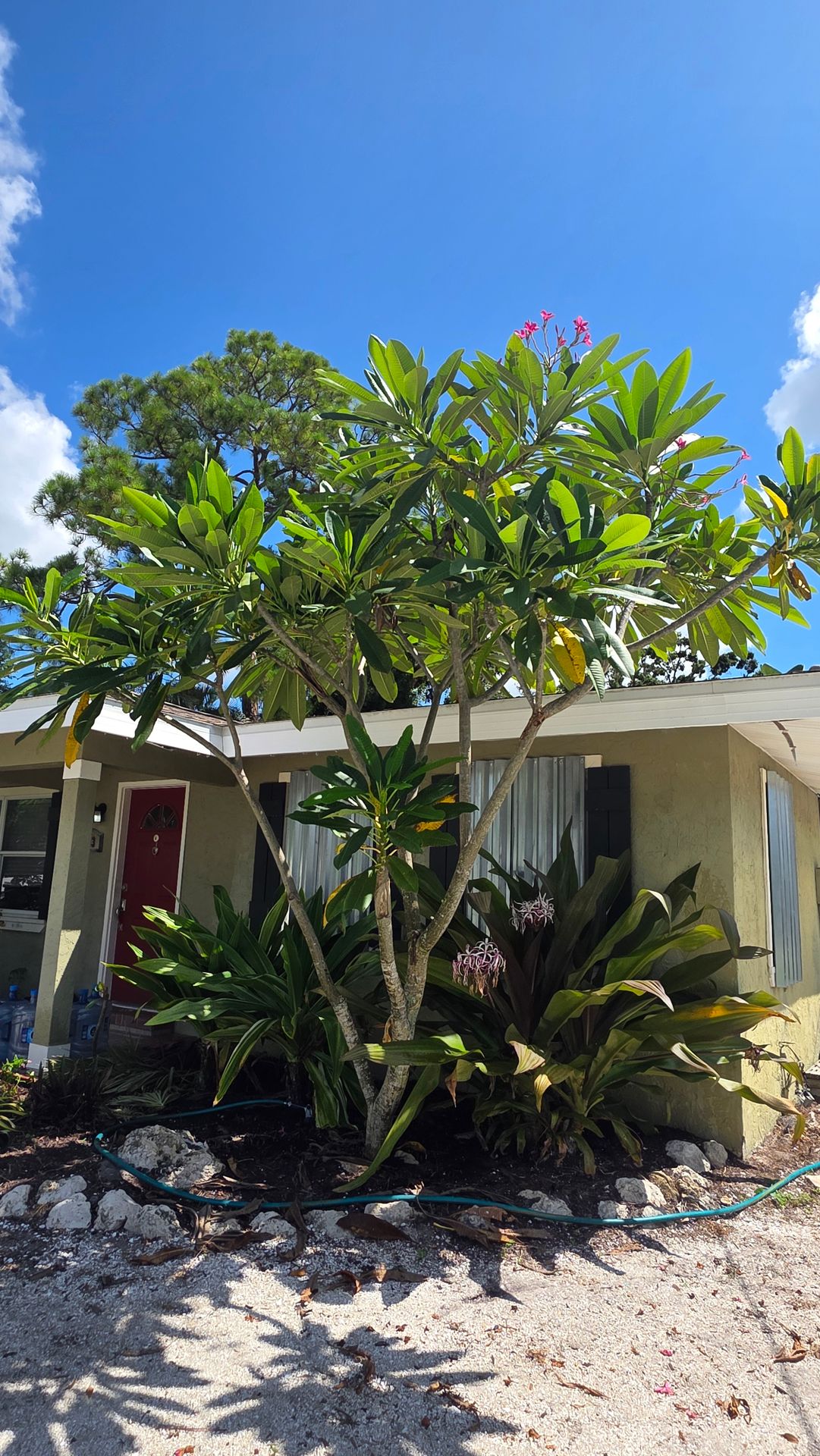
Large Giant Crinums and Queen Emma Crinums can eventually occupy a substantial footprint.
That means we generally want to avoid planting them:
• Directly against narrow sidewalks
• In tiny foundation beds
• Where their foliage will constantly block a walkway
• Directly beneath small windows
• Where repeated pruning will be necessary just to keep the plant inside its space
A Crinum that is constantly being cut back because it is “too big” is often not a pruning problem.
It is a placement problem.
Sun, Soil and Water
As a group, Crinums are surprisingly adaptable, but the exact needs depend on the species.
Many ornamental Crinums perform well from full sun through partial shade.
Established Giant Crinums and similar ornamental types can tolerate periods of relatively dry conditions once established.
Florida Swamp Lily sits much closer to the wet end of the spectrum.
It naturally prefers moist or wet soils.
That difference illustrates why identifying the Crinum matters.
Two plants may have similar flowers while having very different preferences for where they should be planted.
Flowers Are Only Half the Appeal
The flowers usually get the attention, but Crinums can remain visually useful long after a bloom cycle ends.
Their foliage has enough mass to create structure in a landscape.
Giant Crinum contributes large green tropical leaves.
Queen Emma adds burgundy and purple tones.
Swamp Lily provides a softer native wetland character.
That makes Crinums particularly useful when they are treated as foliage plants first and flowering plants second.
The flowers then become the bonus.
One Florida Pest Really Likes Crinums
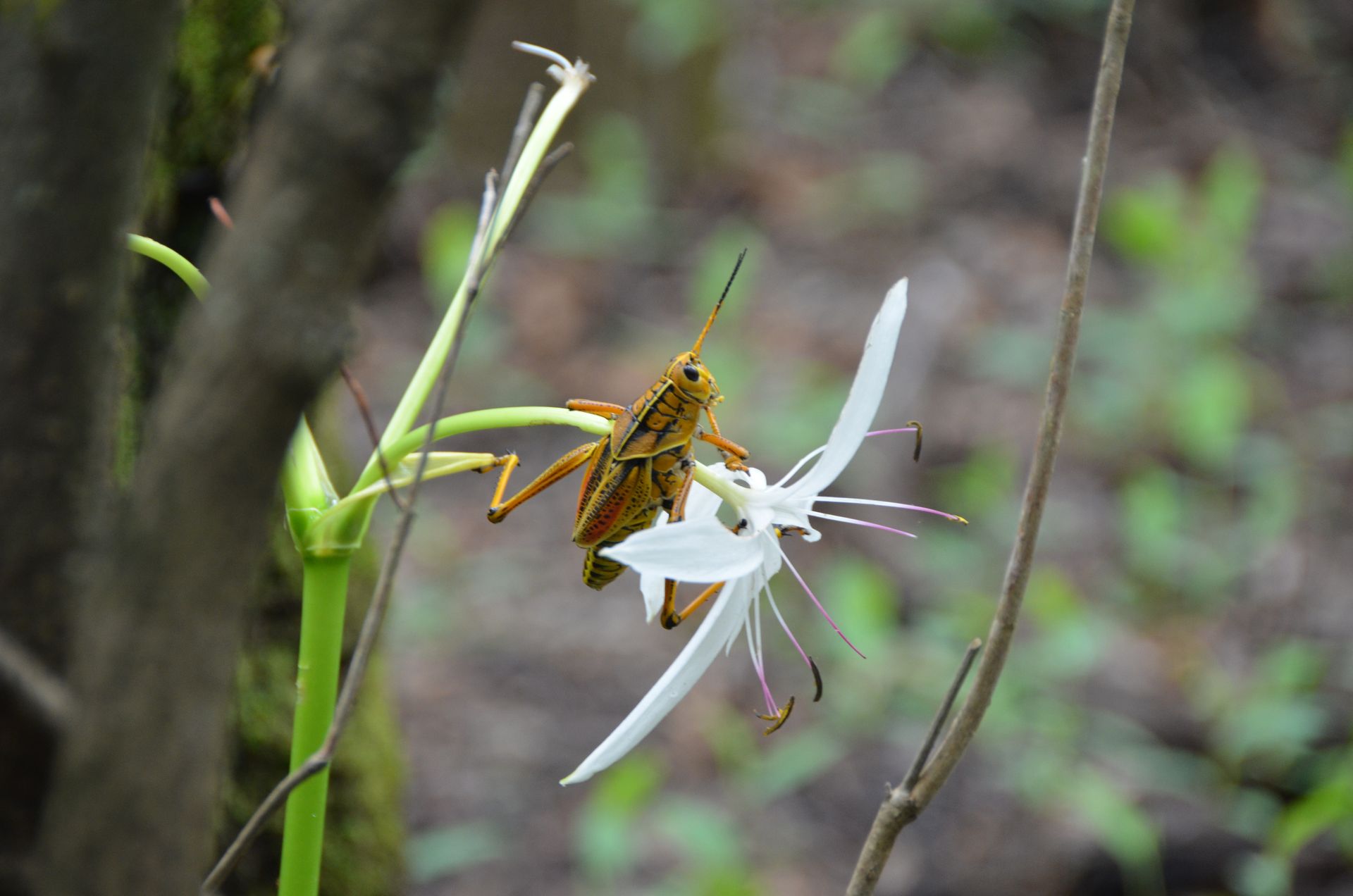
There is one Florida insect worth mentioning whenever Crinums come up:
Eastern lubber grasshoppers.
Lubbers can feed heavily on Crinum foliage.
Large adult lubbers are difficult to miss, but younger nymphs are much smaller and easier to control before they become the giant black, orange and yellow grasshoppers familiar to many Florida gardeners.
Regular observation during spring can help catch an infestation before significant foliage damage occurs.
Leaf Spotting, Older Foliage and Beneficial Insects
Mature Crinums are not always picture-perfect.
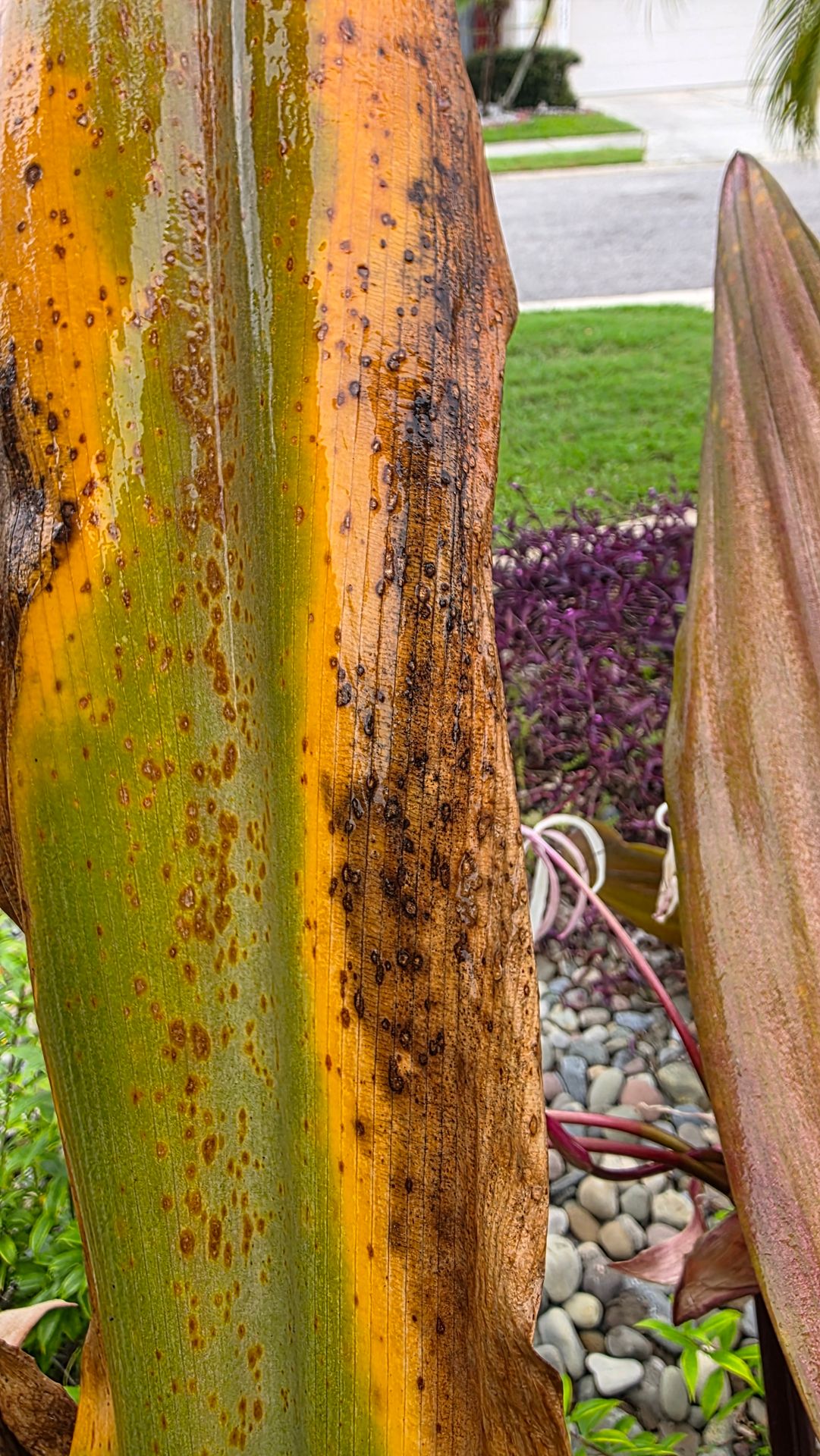
Older leaves can develop yellowing, browning and spotting, particularly in Florida’s warm, humid conditions. UF/IFAS notes that leaf-spot diseases can occasionally affect Crinums and may become more noticeable in moist or shaded areas.
The Queen Emma Crinum pictured here showed extensive spotting, yellowing and areas of dead tissue on older foliage.
While inspecting the same plant, we also found something that could easily be mistaken for another pest problem.
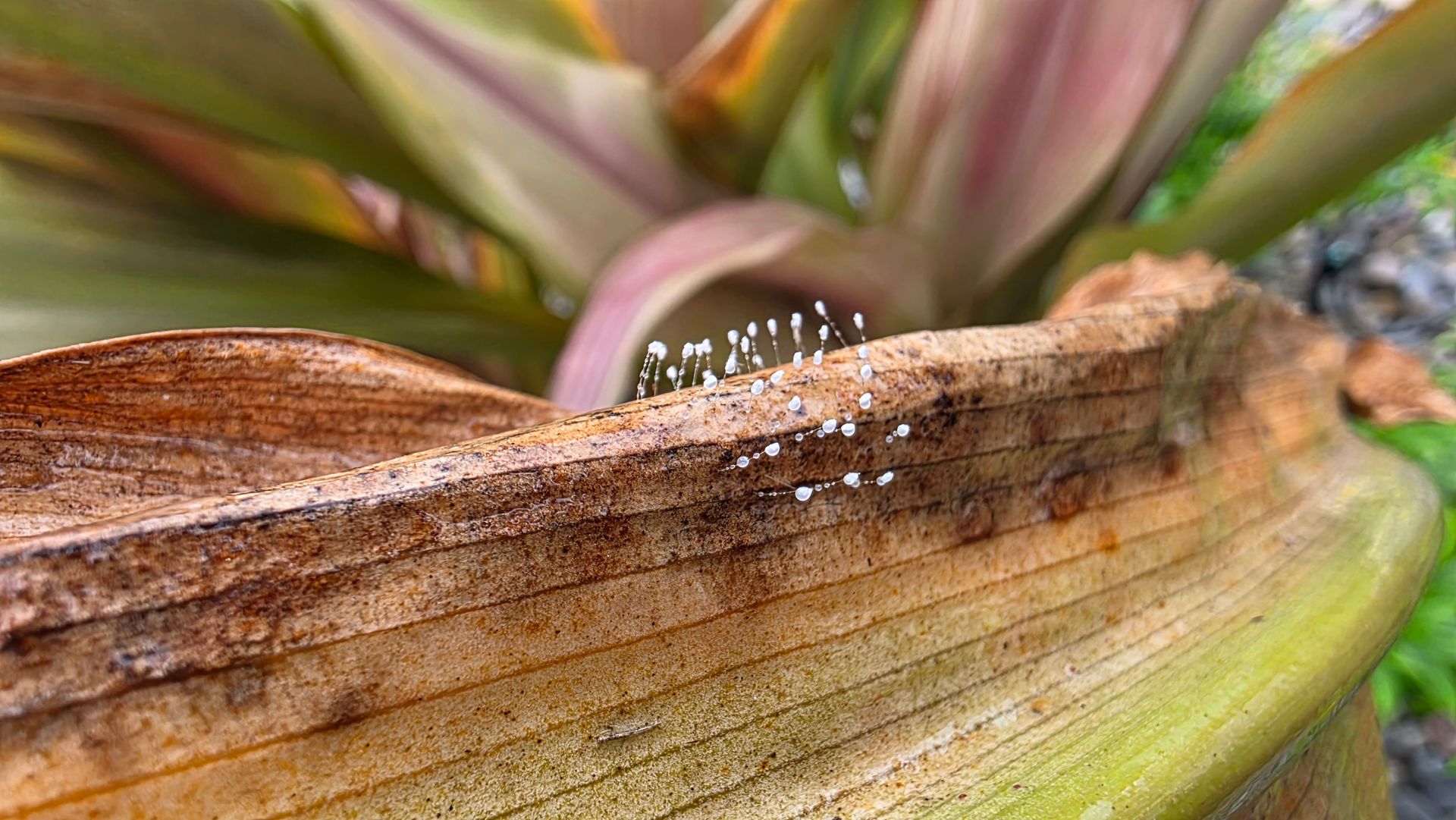
Green lacewings deliberately suspend their eggs on tiny stalks. Their larvae are beneficial predators that feed on other insects and mites.
So in this case, one of the strangest-looking things on the damaged foliage was actually something we would generally be happy to find.
It is a good reminder not to assume every insect, egg or unusual structure on a declining plant is responsible for the damage.
Crinums Are Classic Passalong Plants
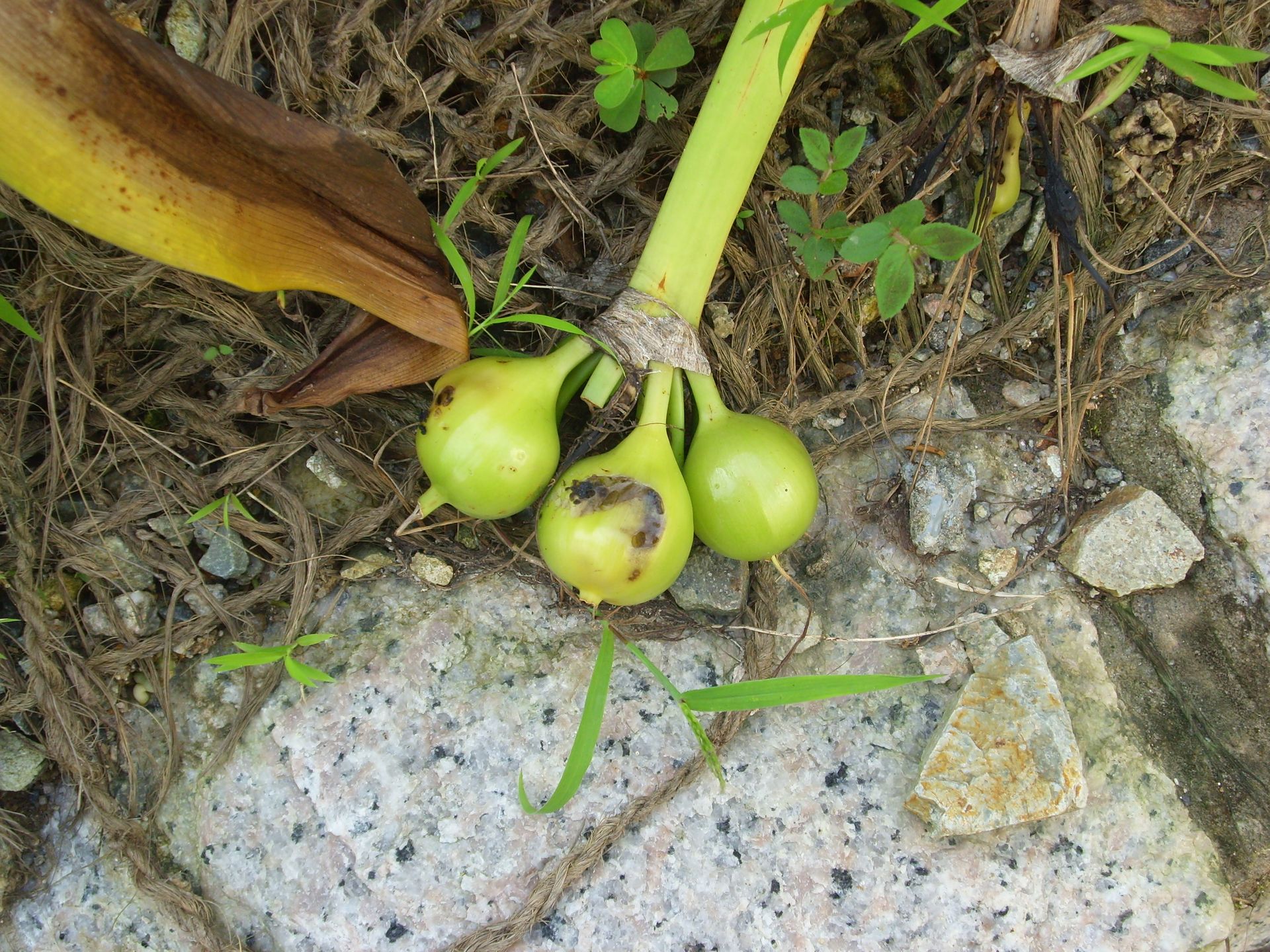
Crinums can also produce rounded fruit capsules after flowering when pollination is successful. Those capsules contain seeds, giving the plants another way to reproduce in addition to the offsets that develop around established clumps.
Established clumps can produce offsets around the original bulb.
As the clump expands, these offsets can eventually be divided and replanted elsewhere.
That ability to divide an old plant and give part of it to somebody else is one reason certain Crinums have persisted in Southern gardens for generations.
Some plants growing in landscapes today may effectively be descendants of bulbs that have been moved from yard to yard for decades.
A Word About Toxicity
Despite the word “lily” in their common names, Crinums belong to the Amaryllidaceae family.
They contain alkaloids that can be toxic if consumed.
That is especially worth remembering in landscapes where pets or young children may chew plants.
This does not make Crinums inappropriate landscape plants.
It simply means homeowners should know what they are growing.
Which Crinum Fits the Landscape?
The right choice depends heavily on the site and the look you are trying to create.
For a massive green tropical accent:
Giant Crinum
For dramatic dark foliage with pink-and-white flowers:
Queen Emma Crinum
For a Florida-native Crinum in a genuinely moist location:
Florida Swamp Lily
That difference is what makes the group so interesting.
They share an unmistakable family resemblance — broad foliage, substantial bulbs and exotic flower clusters — while filling very different roles in the landscape.
Crinums in Sarasota Landscapes
Crinums are one of those plants that can look fairly ordinary when young and extraordinary once mature.
A good specimen can eventually become a major feature in the landscape rather than simply another flowering plant.
We especially like the larger forms where there is enough room to appreciate their natural scale instead of constantly cutting them back to fit a space that was too small from the beginning.
And Florida Swamp Lily gives us a completely different opportunity: a true Florida native for wet areas where many conventional landscape plants struggle.
The lesson is the same with all three.
Choose the plant for the site.
Give it the conditions and space it needs.
Then let it become what it is supposed to become.
Learn More
Giant Crinum Lily — StrongSRQ Plant Gallery
https://strongsrq.com/accent-plants-2/giant-crinum-lily
Queen Emma Crinum — StrongSRQ Plant Gallery
https://strongsrq.com/accent-plants-2/queen-emma-crinum
Explore the StrongSRQ Florida Plant Gallery
https://strongsrq.com/plant-gallery
Continued Reading & References
University of Florida / IFAS Gardening Solutions — Crinums
https://gardeningsolutions.ifas.ufl.edu/plants/ornamentals/crinums/
University of Florida / IFAS Gardening Solutions — Swamp Lily
https://gardeningsolutions.ifas.ufl.edu/plants/ornamentals/swamp-lily/
UF/IFAS Extension Duval County — It’s Crinum Season Here in Jacksonville
https://blogs.ifas.ufl.edu/duvalco/2023/06/23/crinums/
UF/IFAS Extension Charlotte County — The Queen of Perennials: The Crinum Lily
https://blogs.ifas.ufl.edu/charlotteco/2022/11/16/the-queen-of-perennials-the-crinum-lily/
UF/IFAS Extension Charlotte County — Who Ate the Crinum Lilies?
https://blogs.ifas.ufl.edu/charlotteco/2021/05/12/who-ate-the-crinum-lilies/